The LIPS team, made up of researchers in linguistics and language processing, conducts multidisciplinary research into oral -spoken and signed- languages. It cooperates extensively with other teams in the STL department, as well as with other departments in the laboratory.
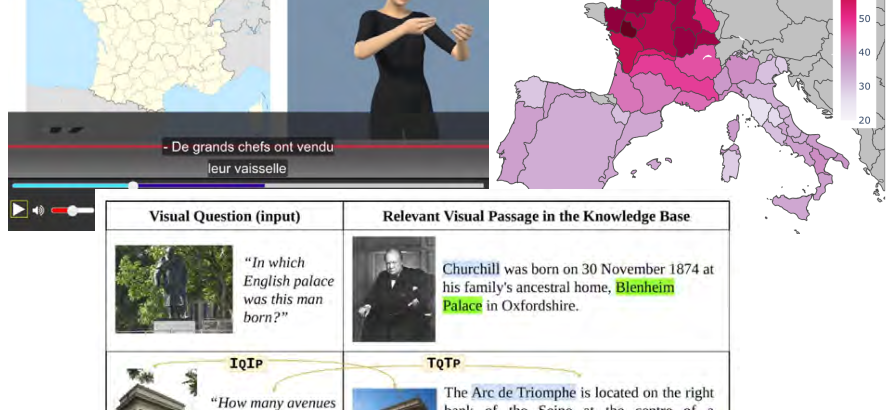
The team’s scientific challenges concern oral, spoken and signed, languages, with the aim of linguistic description and modelling. The team brings together researchers in natural language processing and linguists to focus on the situated dimension of language: we use a variety of data, of different sizes and from different sources, illustrating linguistic variation in all its dimensions, from minimal units to meaning. Multimodal processing involving the written and aural variety of spoken languages as well as other visual information (e.g. occulometry), or owritten and aural varieties of different languages (e.g. sign language videos with French subtitles), is also at the heart of our concerns. Our work gives rise to a variety of applications: speech and sign language recognition and synthesis, dialogue systems. Our research is interdisciplinary by nature and requires skills in signal processing, linguistics and computer science. Our research is interdisciplinary by nature and requires skills in signal processing, linguistics and computer science.
The team’s activities are organised around three themes:
Information retrieval in dialogues
Work on multimodal and conversational information retrieval is centered around two main pillars: incorpo- rating multimodality into information retrieval systems and studying dialogic interactions. In more detail, this research is focused on how to represent multimodal data, taking into account contexts and various multi- modal aspects in the developed representations, and addressing the challenge posed by the scarcity of avail- able data. The artificial intelligence methods implemented also tackle issues related to handling degraded data, continuous and interactive learning, while aiming to make model predictions understandable, with an eye towards explainability.
Sign language modeling and processing
Sign languages, which are poorly endowed languages, have a linguistic system resulting from their visuo-gestural nature: a large amount of information is expressed simultaneously and organized spatially, and iconicity plays a central role. Computer modeling of SL requires the design of representations with little available data, and where pre-existing models, which are essentially linear, have been developed for written or spoken languages and do not cover all aspects of LS. Through projects and PhD theses and in collaboration with signers of these languages (e.g. deaf translators and journalists), we are tackling the following research question: How can SL be analysed, represented and processed? How can we take into account the linguistic specifics linked to their visual-gestural nature (multilinearity, spatialization, iconicity)? What types of approach are possible with little LSF data? Current projects are detailed on this page.
Speech processing and multilingual variation modeling
Research in this theme aims to understand the variation phenomena that underlie temporal and spatial changes in spoken language and to develop models for use in automatic speech processing. One of our objectives is to structure the information in audio documents by developing models and algorithms that rely on diverse information sources and can serve to detect the presence of speech, to identify the lan- guage being spoken and to characterize the speaker(s), to transcribe the speech into text in the same or a different language or identify specific entities or acoustic events. Concerning speech recognition, our research aims to complete the word sequence with punctuation and with paralinguistic information such as hesitations, laughter or breath noises. We also study frugal learning techniques and applied them to speech recognition for low e-resourced languages and tasks.
Michael Filhol, Emmanuella Martinod. Formalising Sign Language Depiction, Characterising Categories and Measuring Iconicity with AZee. Workshop on the representation and processing of Sign Languages, ELRA, May 2026, Palma (Mallorca), Spain. ⟨hal-05861066⟩
Cyril Grouin, Natalia Grabar. Year 2024: Trends towards Multi-[tasks, languages, models] and Large Adoption of LLMs. IMIA Yearbook of Medical Informatics, 2026, 34 (01), pp.292-300. ⟨10.1055/s-0046-1816633⟩. ⟨hal-05874421⟩
Tristan Coignion, Aurélie Bugeau, Gaël Guennebaud, Anne-Laure Ligozat. Measured from the feed: the unsustainable growth of AIArtificial Intelligence video generation. 2026. ⟨hal-05865527⟩
Annelies Braffort, Michael Filhol, Michèle Gouiffès, Julie Halbout, Julie Lascar. Sign Language processing with linguistic knowledge. BMVA Symposium on AIArtificial Intelligence for Sign Language Translation, Production, and Linguistics, Dec 2025, London, United Kingdom. ⟨hal-05861018⟩
Michael Filhol. Représentations formelle et graphique pour la langue des signes. Journée d’études sur le Traitement automatique des langues des signes, Jun 2026, Nancy, France. ⟨hal-05861029⟩
Johanna Cronenberg, Lori Lamel, Ioana Chitoran. To glide or not to glide: Acoustic realization of the diphthong-hiatus contrast in Italian and Romanian. Interspeech 2026, Sep 2026, Sydney, Australia. pp.5616-5620, ⟨10.21437/interspeech.2026-2433⟩. ⟨hal-05855008⟩
Tim Schneider, Michèle Gouiffès, Emmanuelle Frenoux, Céline Clavel, Gérard Kubryk, et al.. Opening up immersion: creating alternative realities in public spaces. Davide Spallazzo; Mauro Ceconello. Designing Immersion in Art and Culture: Insights from Artcast4D Project, FrancoAngeli, pp.37-68, 2024, Design International – Open Access, 978-88-351-6879-9. ⟨hal-05846765⟩
Pauline Beaupoil-Hourdel, Claire Danet, Aliyah Morgenstern. Le diner familial perdu. Ateliers de présentation du projet ANR Dinlang.. Les rencontres de la recherche, Université Sorbonne Nouvelle, May 2024, Paris, France. ⟨hal-04643265⟩
Simon Devauchelle, David Doukhan, Rémi Uro, Lucas Ondel Yang, Valentin Pelloin, et al.. spINAch: A Diachronic Corpus of French Broadcast Speech Controlled for Speakers’ Age and Gender. The Fifteenth Language Resources and Evaluation Conference (LREC 2026), May 2026, Palma, Spain. pp.5805-5820, ⟨10.63317/58hgwvgvkz6g⟩. ⟨hal-05786432⟩
Aurélie Bugeau, Anne-Laure Ligozat, Théophile Lenoir, Gael Guennebaud. Contribution à l’Assemblée Nationale : questionnaire sur les impacts environnementaux de l’intelligence artificielle. Observatoire sur l’impact environnemental de l’IAIntelligence Artificielle, Institut IAIntelligence Artificielle et Société, ENS Paris. 2026. ⟨hal-05800681⟩
Binesh Arakkal Remesh, Thomas Gerald, Camille Guinaudeau, Sahar Ghannay, Eva Feillet. Detection of parametric or contextual knowledge: are the schemas similar across modalities?. UncertaiNLP workshop, Oct 2026, Budapest, Hungary. ⟨hal-05800102⟩
Pierre Lepagnol, Sahar Ghannay, Thomas Gerald, Christophe Servan, Sophie Rosset. Approches de recherche d’information pour l’amélioration des amorces appliquées à la compréhension de la parole avec apprentissage en quelques exemples. 21e Conférence en Recherche d’Information et Applications (CORIA) 19e Rencontres Jeunes Chercheurs en RI (RJCRI) 33e Conférence sur le Traitement Automatique des Langues Naturelles (TALN) 28e Rencontre des Étudiants Chercheurs en Informatique pour le Traitement Automatique des Langues (RÉCITAL), Jun 2026, Nantes, France. pp.10-10. ⟨hal-05786069⟩
Fanny Ducel, Aurélie Névéol, Vidit Khazanchi, Loic Leclere, Arthur Pedrini, et al.. Le code-switching comme indicateur de biais dans les LLM : “The consequences are not the same para nosotros”. 21e Conférence en Recherche d’Information et Applications (CORIA) 19e Rencontres Jeunes Chercheurs en RI (RJCRI) 33e Conférence sur le Traitement Automatique des Langues Naturelles (TALN) 28e Rencontre des Étudiants Chercheurs en Informatique pour le Traitement Automatique des Langues (RÉCITAL), Jun 2026, Nantes, France. pp.1-1. ⟨hal-05786088⟩
Emmett Strickland, Valentina Fedchenko, Marc Evrard. Une étude pilote sur l’affinage des modèles TTS créoles : le vocabulaire lexificateur ou la phonologie du substrat, lequel est le plus déterminant ?. 21e Conférence en Recherche d’Information et Applications (CORIA) 19e Rencontres Jeunes Chercheurs en RI (RJCRI) 33e Conférence sur le Traitement Automatique des Langues Naturelles (TALN) 28e Rencontre des Étudiants Chercheurs en Informatique pour le Traitement Automatique des Langues (RÉCITAL), Jun 2026, Nantes, France. pp.53-54. ⟨hal-05786125⟩
Pierre Lepagnol, Sahar Ghannay, Thomas Gerald, Christophe Servan, Sophie Rosset. De l’importance des formats : une évaluation critique des formats de sorties dans les amorces des Grands Modèles de Langues pour la compréhension de la parole et la REN. 21e Conférence en Recherche d’Information et Applications (CORIA) 19e Rencontres Jeunes Chercheurs en RI (RJCRI) 33e Conférence sur le Traitement Automatique des Langues Naturelles (TALN) 28e Rencontre des Étudiants Chercheurs en Informatique pour le Traitement Automatique des Langues (RÉCITAL), Jun 2026, Nantes, France. pp.11-11. ⟨hal-05786095⟩
Ayoub Hammal, Pierre Zweigenbaum, Caio Corro. Un formalisme fondé sur des approximations du problème du sac à dos pour modéliser l’alignement. 21e Conférence en Recherche d’Information et Applications (CORIA) 19e Rencontres Jeunes Chercheurs en RI (RJCRI) 33e Conférence sur le Traitement Automatique des Langues Naturelles (TALN) 28e Rencontre des Étudiants Chercheurs en Informatique pour le Traitement Automatique des Langues (RÉCITAL), Jun 2026, Nantes, France. pp.52-52. ⟨hal-05786124⟩
Fanny Ducel, Shayan Ahmed Shariff, Ibrahim Al Kotob, Binesh Arakkal Remesh, Lucie Digoin-Caparros, et al.. Are Benchmarks a source of bias in LLMs? MMLU, CommonSenseQA and MGSM under the Microscope. EMNLP 2026 – Conference on Empirical Methods in Natural Language Processing, Oct 2026, Budapest, Hungary. ⟨hal-05783214⟩
Younes Boufouss, Luc Pommeret. Natural Language Inference using Enhanced Knowledge Graphs for Multi-Hop Reasoning. JDSE 2026 – 11th Junior Conference on Data Sciences and Engineering, Sep 2026, Orsay, France. . ⟨hal-05765575⟩
Lucía Catalán Gris, Kim Gerdes, John S Y Lee. The Linguist’s Lie Detector: Linguistic Knowledge in Large Language Models. NSLP 2026 @ LREC 2026 – 3rd International Workshop on Natural Scientific Language Processing, May 2026, Palma de Mallorca, Spain. pp.235-246, ⟨10.63317/2f7zobe6yo7h⟩. ⟨hal-05652276⟩
Jianying Liu, Kim Gerdes, Jean-Marc Deltorn. Beyond frequency measures: Can contextual embeddings capture meaning change in scientific texts?. JADT 2026 – 18th International Conference on Statistical Analysis of Textual Data, Jul 2026, Palermo, Italy. pp.232-241. ⟨hal-05731086⟩
Marta López-Rauhut, Loic Landrieu, Mathieu Aubry, Anne-Laure Ligozat. Environmental Footprint of GenAI Research: Insights from the Moshi Foundation Model. Transactions on Machine Learning Research , 2026. ⟨hal-05749590⟩
Younes Boufouss, Luc Pommeret, Thomas Gerald, Patrick Paroubek, Sophie Rosset. Can We Do Interpretable NLI with Graphs Based on Atomic Propositions?. AKBC @ EMNLP, ACL, Oct 2026, Budapest, Hungary. ⟨hal-05745292v3⟩
Anisia Popescu, Lori Lamel, Marc Evrard, Ioana Vasilescu. Tracking /r/ Deletion: Forced Alignment of Pronunciation Variants and Sociophonetic Insights into Post-Obstruent Final /r/ in French. Interspeech 2025, Aug 2025, Rotterdam, Netherlands. pp.2945 – 2949, ⟨10.21437/interspeech.2025-967⟩. ⟨hal-05682650⟩
Agnieszka Dryjańska, Till Überrück-Fries, Agata Savary. Identification and annotation of multiword expressions in an end-user application: The case of teaching/ learning French as a foreign language. Verginica Barbu Mititelu; Voula Giouli. Multiword expressions in Natural Language Processing: Current trends and challenges, 8, Language Science Press, pp.225-254, 2026, Phraseology and Multiword Expressions, 978-3-96110-591-5. ⟨10.5281/zenodo.21277679⟩. ⟨hal-05734416⟩
Dylan Sechet, Marc Evrard, Matthieu Kowalski. Simulation-Based Inference for Plate Reverb System Identification. DAFX 2026 – 29th International Conference on Digital Audio Effects, Sep 2026, Cambridge, United States. ⟨hal-05742718⟩
Alex Colagrande, Paul Caillon, Eva Feillet, Alexandre Allauzen. Linear Attention with Global Context: A Multipole Attention Mechanism for Vision and Physics. ICCVW 2025 – IEEE/CVF International Conference on Computer Vision Workshops, Oct 2025, Honolulu, United States. pp.3130-3139, ⟨10.1109/ICCVW69036.2025.00326⟩. ⟨hal-05742260⟩
Alex Colagrande, Paul Caillon, Eva Feillet, Alexandre Allauzen. Limits of Resolution Equivariance in Fourier Neural Operators. AIArtificial Intelligence&PDE: ICLR 2026 Workshop on AIArtificial Intelligence and Partial Differential Equations, Apr 2026, Rio de Janeiro, Brazil. arXiv, 2026, ⟨10.48550/arXiv.2606.00677⟩. ⟨hal-05742295⟩
Adèle Jatteau, Jinyu Li, Lori Lamel. Y a-t-il des géminées en français ? Une étude acoustique des mots en dans de grands corpus de parole. Congrès mondial de linguistique française, Jul 2026, Arras, France. pp.09008, ⟨10.1051/shsconf/202623209008⟩. ⟨hal-05740510⟩
Ayoub Hammal, Pierre Zweigenbaum, Caio Corro. On the Rejection Criterion for Proxy-based Test-time Alignment. ACL 2026 – 64th Annual Meeting of the Association for Computational Linguistics, Jul 2026, San Diego, United States. pp.547-554, ⟨10.18653/v1/2026.acl-short.46⟩. ⟨hal-05689863⟩
Clémentine Bleuze, Karën Fort, Vincent P Martin, Aurélie Névéol. Large Language Models for Mental Health Prediction: Scoping Review of Bias and Clinical Utility Documentation in 2019-2024. JMIR AIArtificial Intelligence, 2026, 5, pp.e88082-e88082. ⟨10.2196/88082⟩. ⟨hal-05717650⟩
Marco Naguib, Christel Gérardin, Victor Beaucoté, Cyril Charron, Adrien Joseph, et al.. Evaluating the Retrieval Component in a Retrieval-Augmented Summarization System for Patient Records in French. LREC 2026 – 15th biennial Language Resources and Evaluation Conference, May 2026, Palma, Spain. pp.57-65, ⟨10.63317/4cy8xxinjw7z⟩. ⟨hal-05716360⟩
Aygalic Jara-Mikolajczak, Thomas Lavergne, Christophe Servan, Sophie Rosset. Robustesse des LLM dans les contextes longs, hallucinations et détection sur questions-réponses séquentielles. 21e Conférence en Recherche d’Information et Applications (CORIA) 19e Rencontres Jeunes Chercheurs en RI (RJCRI) 33e Conférence sur le Traitement Automatique des Langues Naturelles (TALN) 28e Rencontre des Étudiants Chercheurs en Informatique pour le Traitement Automatique des Langues (RÉCITAL), Jun 2026, Nantes, France. pp.512-523. ⟨hal-05708368⟩
Zhongjie Li, Rim Abrougui, Guillaume Lechien, Elisabeth Savatier, Benoît Laurent, et al.. Sem-G-RAG, combiner sémantique symbolique à base de graphes et LLM pour le RAG. 21e Conférence en Recherche d’Information et Applications (CORIA) 19e Rencontres Jeunes Chercheurs en RI (RJCRI) 33e Conférence sur le Traitement Automatique des Langues Naturelles (TALN) 28e Rencontre des Étudiants Chercheurs en Informatique pour le Traitement Automatique des Langues (RÉCITAL), Jun 2026, Nantes, France. pp.544-563. ⟨hal-05708371⟩
Eve Sauvage, Cyril Grouin, Julien Tourille. Tous les tokens sont-ils utiles pour les modèles de langues ?. 21e Conférence en Recherche d’Information et Applications (CORIA) 19e Rencontres Jeunes Chercheurs en RI (RJCRI) 33e Conférence sur le Traitement Automatique des Langues Naturelles (TALN) 28e Rencontre des Étudiants Chercheurs en Informatique pour le Traitement Automatique des Langues (RÉCITAL), Jun 2026, Nantes, France. pp.595-609. ⟨hal-05708373⟩
Oumaima El Khettari, Virgile Barthet, Guillaume Hocquet, Joconde Weller, Emmanuel Morin, et al.. Is Clinical Text Enough? A Multimodal Study on Mortality Prediction in Heart Failure Patients. LREC 2026 – 15th biennial Language Resources and Evaluation Conference, May 2026, Palma, Spain. pp.194-206, ⟨10.63317/47hsfchk79n6⟩. ⟨hal-05709146⟩
Lounès Kebdi, Lubin Longuépée, Mathilde Aguiar, Pierre Zweigenbaum, Nona Naderi. Impact de l’affinage de modèles génératifs pour l’inférence en langue naturelle appliquée aux essais cliniques : comparaison avec des approches de *few-shot learning. 21e Conférence en Recherche d’Information et Applications (CORIA) 19e Rencontres Jeunes Chercheurs en RI (RJCRI) 33e Conférence sur le Traitement Automatique des Langues Naturelles (TALN) 28e Rencontre des Étudiants Chercheurs en Informatique pour le Traitement Automatique des Langues (RÉCITAL), Jun 2026, Nantes, France. pp.303-321. ⟨hal-05708357⟩